Oracy
At The Hayes Primary School, we believe that talk is not merely a vehicle for sharing knowledge but a central means by which knowledge is built, understood, refined, and applied. We aim for every pupil to develop confidence, clarity and purpose in speaking and listening across all areas of learning and life.
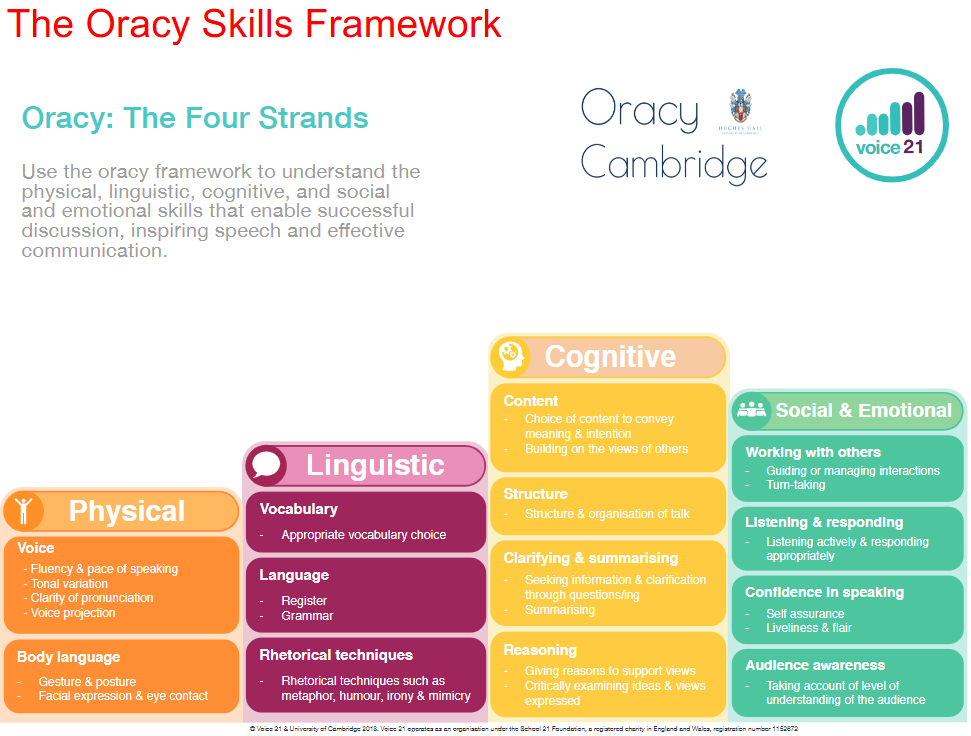
Our oracy ambition is grounded in the Cambridge Oracy (Oracy Cambridge) Skills Framework, which identifies the interdependent strands of physical, linguistic, cognitive and social–emotional skills as essential for powerful spoken communication educ.cam.ac.uk+2ORACY CAMBRIDGE+2. We hold that oracy is not an “add-on” but core to excellent teaching and learning: as pupils learn through talk (dialogic teaching) and learn how to talk (oracy education) Cambridge International+2ORACY CAMBRIDGE+2.
We see oracy as a bridge between curriculum content and pupils’ deeper thinking: talk enables inter-thinking (thinking together) and helps learners articulate, challenge, refine, and extend their ideas. At The Hayes, we expect all staff to cultivate a culture of high-quality talk - safe, inclusive, purposeful - so that pupils flourish as articulate, thoughtful communicators and listeners.
Intent
By implementing our Oracy Curriculum, we intend that:
- Pupils across all year groups will develop the full repertoire of oracy skills (physical, linguistic, cognitive, social-emotional).
- Talk will be deliberately planned, scaffolded, and modelled across all curriculum areas, not confined to English or “Speaking & Listening” lessons.
- Pupils will progressively take increasing responsibility for the quality of their talk (planning, monitoring, reflecting).
- Teachers will employ dialogic teaching strategies, balancing presentation and interactive dialogue to deepen learning and engagement
- Oracy development will be evidenced, assessed, and reviewed, enabling staff to respond to pupils’ strengths and needs.
- Through strong oracy, we will enhance pupils’ confidence, reasoning, vocabulary, listening skills and civic agency (the capacity to argue, question, listen, and persuade respectfully).
Implementation
Culture & Expectations
- We will establish a shared language of talk (e.g. “exploratory talk,” “effective listener,” “audience awareness”) to be used consistently by all staff and pupils.
- Each class will co-construct oracy ground rules / discussion norms (e.g. taking turns, building on others’ ideas, justifying reasoning).
- Talk will be valued publicly: pupil contributions, careful questioning, metatalk (reflection on the talk) will be routinely highlighted and celebrated.
- Across the school, oracy displays will remind pupils of effective talk skills (linking to the four strands).
- There will be opportunities beyond the classroom (assemblies, pupil voice, debates, performances) to apply and celebrate oracy.
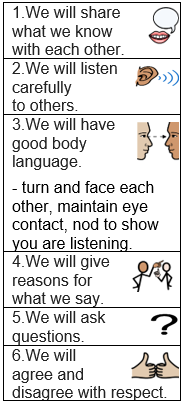
The Hayes Speaking and Listening Ground Rules
Pedagogical Strategies
To realise our oracy ambition, teachers will:
- Model high-quality talk explicitly: demonstrating use of pace, clarity, gesture, vocabulary, reasoning.
- Use scaffolds for planning talk, such as speaking frames, graphic organisers, rehearsal time, peer coaching.
- Structure dialogic tasks such as: paired talk, triads, small-group dialogue, philosophical discussion, fishbowl, “think-pair-share,” structured debates.
- Embed metacognitive reflection on talk: regular sessions where pupils review how the talk went, what was effective or challenging and set targets for next time.
- Use cognitive scaffolds (e.g. question stems, prompts for justification, summarising) to support reasoned talk.
- Differentiate oracy support as needed (e.g. sentence starters, visual scaffolds, talk buddies), to ensure all pupils including EAL, SEN, or reluctant speakers can access high-quality talk.
- Gradually fade scaffolds so pupils internalise talk skills over time.
Curriculum Planning
- Each subject curriculum document will explicitly identify opportunities for talk (e.g. discussion, explanation, justification).
- Planning will indicate intended talk objectives and scaffolds (linked to the four strands).
- Themes, texts, problems and tasks will be selected to stimulate debate, divergent thinking, discussion and justification, not only recall.
- Rich questioning (open, probing, follow-up) will be integral: teachers will plan up-level and extension questions.
- Units or lessons will incorporate cycles of exploratory talk, presentation or consolidation talk, enabling pupils to refine before output.
- We will adopt the Oracy Framework Progression Tool from Voice 21
Professional Development & Coaching
- The school will provide ongoing training and coaching on oracy, dialogic teaching and the Cambridge Oracy Skills Framework.
- Professional development will include specific training on supporting oracy development in children with SEND and EAL, including strategies to overcome communication barriers and promote confidence.
- Senior leaders and subject leads will monitor talk practices (via learning walks, observations, book scrutiny) and provide feedback.
- The Oracy Senior Leader and Oracy Lead will disseminate practice, curate resources and lead staff development.
- New staff induction will include training in our oracy expectations and strategies.
Assessment, Monitoring & Progress
- We will use oracy assessment tasks and rubrics (e.g. adapted from Cambridge’s oracy toolkit) to benchmark pupils’ oracy skills, track progression, and inform planning educ.cam.ac.uk+1.
- Each year group will select oracy focus tasks (presentation, group talk, debating) at baseline and end points.
- Teachers will maintain oracy profiles for pupils, noting strengths, areas for growth, and interventions.
- Learning walks and observations will include a “talk lens” to evaluate the quality, balance and scaffold of talk.
Environment & Resources
- Classrooms will be configured to promote talk.
- Visual prompts for talk (e.g. question stems, talk scaffolds, norms) will be visible.
- A dedicated oracy resource bank (print, digital) will be maintained (e.g. discussion cards, debate materials, exemplar videos).
- Library and curriculum displays will showcase models of excellent spoken texts (e.g. speeches, debates).
- Technology (e.g. microphones, audio recording) may be used to record and replay pupil talk for reflection.
- The school will audit and improve playground and communal areas to promote positive social interactions and oracy opportunities during unstructured times, linking to the school’s priority to improve play and interaction
Impact
We expect this approach to lead to the following outcomes:
- Pupils will increasingly demonstrate confidence, clarity, coherence, articulation and listening as speakers and interlocutors.
- Talk will enable deeper thinking, reasoning and conceptual understanding across subjects.
- Teachers will report more engagement, higher quality pupil contributions and more diagnostic insight into pupil thinking.
- Pupil verbal fluency and capacity to debate, explain, argue and question will improve.
- External measures (e.g. national tests, moderation) will show improved performance in reading, writing, reasoning, underpinned by stronger spoken language.
- The school will evidence a sustained culture of high-quality talk, embedded in pedagogical practice.
To check impact, at review points we will compare baseline vs. end-of-year oracy assessments, monitor shifts in classroom discourse (via observations), and gather pupil and staff feedback on talk culture.